Every major observability vendor promised AI would fix on-call. Most delivered chatbots that regurgitated documentation. The gap between hype and help comes down to evidence: can the system show *why* it believes checkout failed — with links to the exact metric panel, log line, and deploy — or does it merely sound confident?
Acme AI was built for the second model. When an alert fires, it ingests the alert context, queries recent telemetry across metrics logs and traces, checks deployment and feature-flag events, and produces a ranked list of hypotheses with confidence scores. Each hypothesis includes clickable evidence — not prose paragraphs engineers must trust blindly.
The training problem is different from consumer LLMs. We do not need a model that writes poetry; we need one that correlates time series and structured events under strict latency budgets. Acme AI runs retrieval-augmented analysis over your indexed telemetry — grounded in your actual data, not internet-scale pretraining that hallucinates kubectl commands.
Consider a typical payment failure incident. Legacy workflow: engineer opens six tabs, correlates timestamps manually, asks in Slack if anyone deployed. Acme AI workflow: alert fires, AI summary posts to the incident channel within 90 seconds suggesting a database connection pool exhaustion correlated with deploy v2.14.3, with links to pool metrics and the deploy diff. Engineer verifies in two clicks — total triage under five minutes.
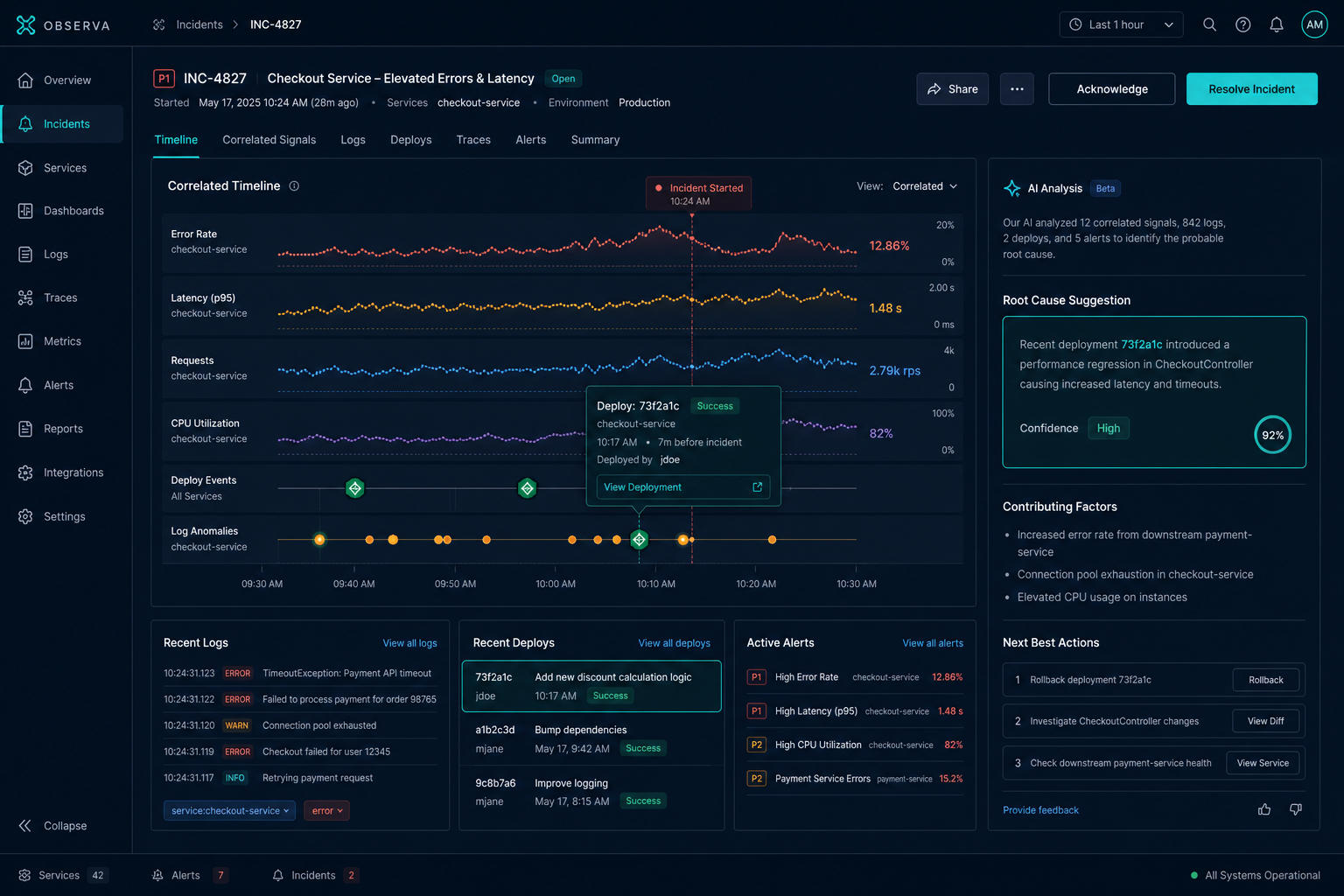
AI does not replace the Incident Commander. It reduces the cold-start problem — the blank screen between page and first useful hypothesis. Teams report 40–50% MTTR reduction on incidents where AI summaries were used versus control groups in our customer studies. The effect is largest for engineers unfamiliar with a given service's history.
Privacy and data boundaries matter. Acme AI analyzes only telemetry in your tenant. Summaries do not train cross-customer models without explicit opt-in. Enterprise customers can disable external model providers entirely and run analysis against Acme-hosted models in their chosen region.
False positives happen. When AI suggests the wrong root cause, thumbs-down feedback adjusts future ranking for similar alert types in your org. The system improves from your corrections — unlike static runbooks that rot until someone edits them.
Post-incident drafts are the underrated feature. After resolution, Acme AI generates a postmortem skeleton: timeline, impact scope, contributing factors, and suggested action items from similar past incidents. Engineers edit rather than write from scratch — cutting postmortem completion time from days to hours.
Adoption succeeds when AI meets teams in existing workflows — Slack, PagerDuty, the Acme incident channel — not in a separate chat window engineers forget exists. Enable AI summaries on one high-churn service first. Measure time-to-first-hypothesis for a month before rolling platform-wide.
The future is not lights-out ops. It is engineers spending cognitive budget on fixes instead of forensic data gathering. Try Acme AI on Growth plan, connect your highest-incident service, and compare your next three postmortems to the three before. The difference in evidence quality — and sleep — is measurable within weeks.