Kubernetes made it effortless to scale workloads — and accidentally effortless to scale bills. Platform teams at mid-size companies routinely spend $40,000–$120,000 per month on compute and observability combined, with 30–45% attributable to over-provisioned nodes, idle namespaces, and metric cardinality explosions. The good news: you rarely need to choose between cost and visibility.
Start with node pool right-sizing. Acme's Infrastructure dashboard shows actual CPU and memory utilization percentiles per node pool over 30 days — not peak spikes that justify oversized instances. Teams that migrate from m5.2xlarge defaults to bin-packed m5.xlarge pools typically save 25–35% on compute without changing application code.
Next, audit metric cardinality. Every unique label combination creates a new time series. A common mistake is injecting unbounded labels like user ID, request ID, or pod name into application metrics. Prometheus and OpenTelemetry will happily store them; your invoice will not happily reflect it. Cap high-cardinality labels at ingestion or drop them in the collector pipeline.
Log volume follows similar rules. Debug-level logs in production, full request/response bodies, and unparsed JSON blobs inflate ingest costs linearly. Acme's log pipelines support sampling rules: keep 100% of errors, 10% of success paths, and route verbose debug streams to short-retention cold storage. Apex Financial cut log ingest from 800 GB/day to 290 GB/day with no loss of incident debuggability.
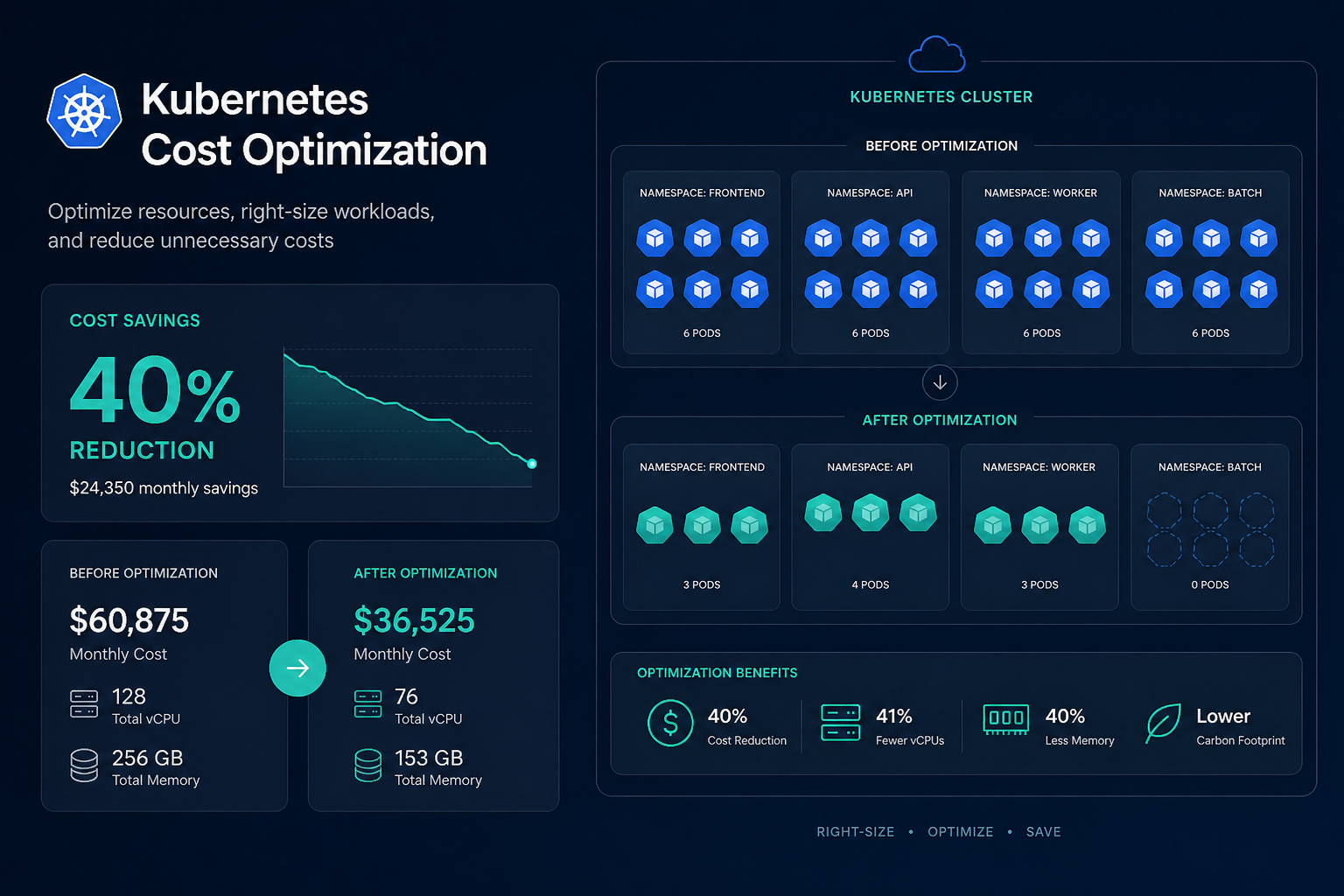
Use vertical pod autoscaling recommendations before horizontal scaling. Many services request 2 CPU cores because someone copied a Helm values file three years ago while actually consuming 0.3 cores at p99. Acme surfaces request-vs-usage gaps per deployment so you can tune Kubernetes resource blocks with evidence.
Namespace-level chargeback changes behavior. When product teams see their observability and compute costs in a monthly Acme report tied to their namespace labels, debug log volume mysteriously decreases. FinOps is not about shame — it is about giving owners the data to make tradeoffs.
Observability itself has a cost line item. Acme Growth plan includes 500 GB of logs monthly; exceeding that triggers predictable overage rather than surprise invoices. Set budget alerts at 80% of included ingest so you adjust pipelines before month-end.
Reserved instances and spot node pools for non-production clusters are low-hanging fruit. Your staging environment does not need the same redundancy as production. Schedule scale-to-zero on preview environments overnight if your CI/CD allows cold starts.
Do not solve cost problems by reducing retention below what your compliance team requires. Shorter metric retention saves money but destroys incident forensics. Prefer aggregation: roll up minute-level data to hourly after seven days while keeping full resolution for recent windows.
Build a quarterly cost review ritual: platform leads, finance, and one product representative review Acme's cost attribution dashboard, pick two actions, and measure savings the following quarter. Cascade Retail saved $18,000 per month in six weeks by combining node right-sizing with cardinality caps — and their MTTR actually improved because dashboards loaded faster with fewer series.